A water softener is an investment in your home’s plumbing, appliances, and everyday comfort. By reducing the calcium and magnesium minerals responsible for hard water, a properly functioning water softener can help prevent scale buildup, reduce soap and detergent waste, and make household cleaning easier.
But like any household appliance, a water softener won’t last forever.
If your system is getting older, requiring frequent repairs, or no longer producing consistently soft water, you may be wondering: How long does a water softener last, and is it better to repair or replace it?
Most traditional water softeners last approximately 10 to 15 years, although some well-maintained systems can operate effectively for 20 years or longer. Their actual lifespan depends on several factors, including water hardness, household water usage, system quality, and maintenance.
For homeowners in Santa Maria, Paso Robles, and surrounding Central Coast communities, where hard water can be a significant concern, understanding these factors is especially important.
Let’s explore what affects your water softener’s lifespan, how to recognize potential problems, and when repairing, replacing, or switching to a convenient portable exchange tank service makes the most sense.
How Long Does a Water Softener Typically Last?
The average water softener lifespan is approximately 10 to 15 years, but not every system ages at the same rate.
A high-quality water softener that is properly sized, installed, and maintained may continue working well beyond that range. Meanwhile, a poorly maintained or undersized system may experience problems much sooner.
Here’s a general guide to what you might expect:
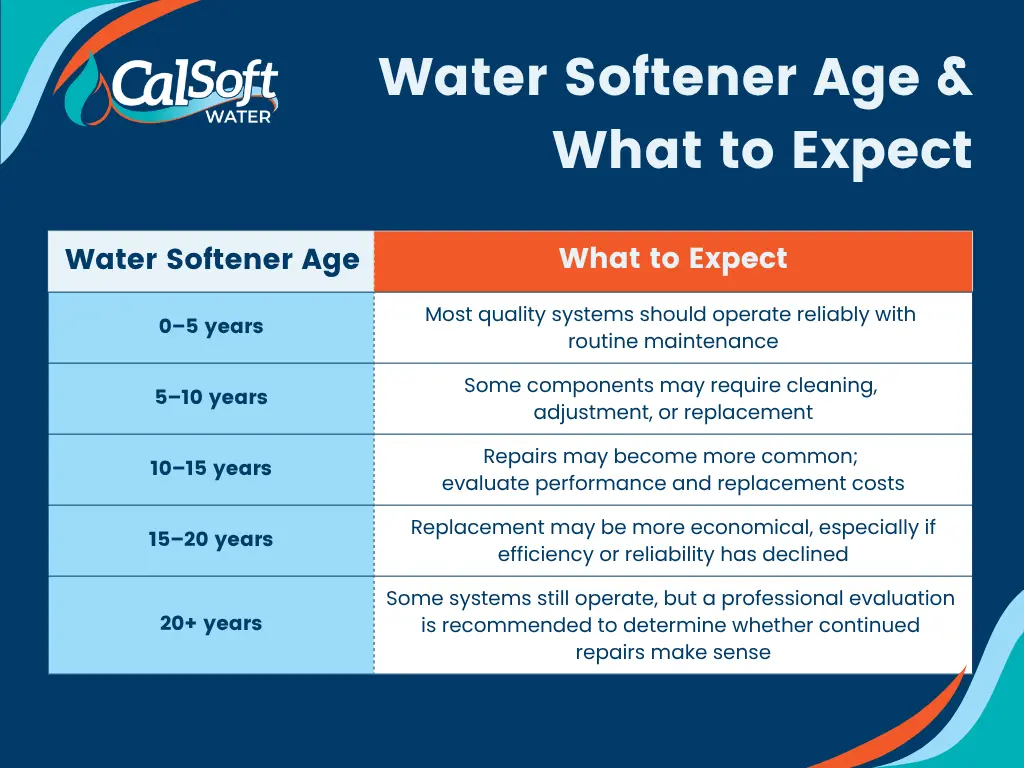
These are general estimates, not guaranteed replacement timelines. The condition of your system matters more than its age alone.
For example, a 12-year-old water softener that consistently produces soft water and has required minimal maintenance may still have years of useful service ahead. On the other hand, an eight-year-old system with repeated mechanical failures may be a better candidate for replacement.
The best way to determine whether your water softener is nearing the end of its useful life is to evaluate its actual performance, repair history, and operating efficiency.
What Factors Affect How Long a Water Softener Lasts?
Several factors influence water softener longevity. Understanding them can help you protect your investment and avoid unnecessary repairs.
1. Your Home’s Water Hardness
Water hardness is one of the most important factors affecting a water softener’s workload.
Hard water contains elevated concentrations of dissolved calcium and magnesium. The harder your water, the more mineral-removal capacity your softener needs.
When a water softener processes highly mineralized water, it may need to regenerate more frequently. This can increase the workload on certain components and make proper system sizing and maintenance especially important.
2. Household Water Usage
The amount of water your household uses also affects your softener’s workload.
For example, a household with six people typically uses more water than a household with two people. More water consumption means the system must remove more hardness minerals.
If your water softener is too small for your household’s needs, it may regenerate more frequently or struggle to keep up with demand.
A properly sized system helps balance softening capacity, regeneration frequency, and overall efficiency.
3. Water Softener Quality
Not all water softeners are built with the same components.
Higher-quality systems often feature durable control valves, dependable resin tanks, and efficient regeneration technology.
A well-designed system may provide more reliable performance and be easier to maintain over time.
When considering a new water softener, it’s worth evaluating long-term reliability and serviceability rather than focusing exclusively on the initial purchase price.
At CalSoft Water, we offer home water softeners designed to address the water quality needs of Central Coast households.
4. Regular Maintenance
Routine maintenance is one of the best ways to extend your water softener’s lifespan.
Depending on your system, maintenance may include:
- Checking salt levels in the brine tank
- Using the appropriate type of water softener salt
- Inspecting for salt bridges or salt buildup
- Cleaning the brine tank when necessary
- Checking for leaks and unusual operation
- Verifying that regeneration cycles are functioning properly
- Testing softened water periodically
- Scheduling professional inspections when performance changes
Neglecting maintenance can allow relatively minor problems to develop into more expensive repairs.
5. Water Quality Beyond Hardness
Hardness isn’t the only water quality factor that can affect a softener.
Depending on your water source, sediment, iron, manganese, chlorine, and other water characteristics may influence the condition of internal components.
For example, sediment can interfere with valves, while elevated iron or manganese may contribute to resin fouling.
Water chemistry can also affect resin longevity.
Professional water testing helps identify these concerns and determine whether additional water treatment is needed to protect your system.
6. Water Softener Settings and Regeneration Frequency
A water softener that regenerates too frequently may waste salt and water. On the other hand, one that regenerates too infrequently may allow hard water into your household plumbing.
Modern demand-initiated systems can use actual water consumption to determine when regeneration is necessary.
Proper programming helps ensure the system operates efficiently while delivering consistent soft water.
For more information, read our related article, Drought & Water Efficiency: Does a Water Softener Waste Water?.
7 Signs Your Water Softener May Need Repair or Replacement
Even a well-maintained system can develop problems as it ages.
Here are seven warning signs that your water softener may need professional attention.
1. Hard Water Symptoms Are Returning
One of the clearest signs of a water softener problem is the return of hard water symptoms.
You might notice:
- White mineral deposits on faucets and fixtures
- Spots on dishes and glassware
- Soap that doesn’t lather as easily
- Stiff or dull-feeling laundry
- Increased scale buildup around showerheads
- Changes in how your skin or hair feels after bathing
These symptoms don’t automatically mean your water softener needs replacement. The problem could be as simple as an empty salt tank, incorrect settings, or a regeneration issue. However, if these problems continue after basic troubleshooting, it’s time for a professional inspection.
2. Your Water Softener Is Using Too Much Salt
If you’re suddenly buying significantly more salt than usual, your water softener may be regenerating too frequently. Possible causes include incorrect programming, valve problems, or changes in household water consumption. A technician can determine whether the system needs an adjustment, repair, or more extensive work.
3. Your System Isn’t Using Salt
A water softener that appears to use little or no salt over an extended period may not be regenerating properly. Potential causes include salt bridging, a clogged brine line, or a malfunctioning control valve.
A salt bridge occurs when a hardened crust forms inside the brine tank, preventing salt from dissolving properly. This is often a repairable problem rather than a reason to replace the entire system.
4. Your Water Softener Is Leaking
Leaks can develop around valves, fittings, hoses, or tanks. Some leaks are relatively simple to repair. Others, particularly those involving a damaged pressure vessel, may make replacement necessary.
If you notice water pooling around your system, contact a professional promptly to prevent water damage.
5. The System Regenerates Constantly or at Unusual Times
A malfunctioning timer, control board, or valve can cause irregular regeneration cycles. This may increase water and salt consumption while reducing overall efficiency. Depending on the age and condition of the system, replacing the faulty component may restore normal operation.
6. Your Water Pressure Has Decreased
A significant drop in household water pressure can sometimes indicate a problem involving the softener’s resin bed, control valve, or internal components. However, low water pressure can also have other plumbing-related causes.
Professional troubleshooting can help determine whether the water softener is responsible.
7. You’re Paying for Frequent Repairs
Occasional repairs are normal, especially as equipment ages. But if your water softener requires repeated service calls, the cumulative cost may begin approaching the price of a new system.
At that point, replacing the unit may provide better long-term value.
When Does It Make Sense to Repair a Water Softener?
Water softener repair is often the best option when the system is relatively young, the problem is isolated, and the cost of fixing it is reasonable.
Repair may make sense in the following situations.
Your Soft Water System Is Less Than 10 Years Old
If your water softener is relatively new and has been reliable, replacing a faulty component may be more economical than buying an entirely new system.
Age alone shouldn’t determine your decision, but a newer unit generally has more potential useful life remaining.
The Problem Is Minor or Inexpensive to Fix
Common repairable issues include:
- Salt bridges
- Clogged injectors or brine lines
- Worn seals or O-rings
- Faulty timers
- Certain control valve problems
- Incorrect regeneration settings
- Minor plumbing connection leaks
When these issues are identified early, repairs may restore normal performance without a major investment.
Replacement Parts Are Readily Available
If the manufacturer still supports your water softener and replacement components are available, repairs may be straightforward.
However, older systems with discontinued parts can become more expensive or difficult to maintain.
Your System Is Otherwise Working Efficiently
If your water softener consistently produces soft water, uses a reasonable amount of salt, and has no history of major problems, repairing one component may be the practical choice.
A professional can evaluate whether the remaining components are likely to provide dependable service.
When Is It Better to Replace a Water Softener?
Sometimes, investing in another repair simply postpones an inevitable replacement.
Here are situations where replacing your water softener may be the smarter choice.
Your Water Softener Is 15 Years Old or Older
An older system isn’t automatically defective.
However, once a water softener reaches 15 years or more, it’s worth considering whether continued repairs provide good value.
If major components are beginning to fail, replacement may be more cost-effective.
The Repair Is Expensive Compared to Replacement
A useful starting point is to compare the total repair estimate with the installed cost of a new system.
For example, if a major repair would cost approximately half the price of a new water softener, replacement deserves serious consideration, particularly when the existing unit is already near the end of its expected lifespan.
This isn’t a strict rule. Warranty coverage, equipment quality, and the remaining condition of the system should also influence the decision.
Multiple Components Are Failing
If your system needs a new control valve, significant resin work, and additional repairs, restoring it may cost more than it’s worth.
A new system could provide greater reliability and reduce the likelihood of additional repair bills.
Your Current System Is Inefficient
Older water softeners may use more salt and water than necessary, particularly if they regenerate on a fixed schedule rather than according to actual household demand.
A properly sized, modern water softener with efficient regeneration controls may reduce operating waste.
The potential savings depend on your existing equipment, water hardness, and usage patterns.
Your Household’s Water Needs Have Changed
Perhaps your family has grown, you’ve added bathrooms, or your water source has changed.
A system that worked well when it was installed may no longer be appropriately sized for your household.
Replacing it gives you an opportunity to select equipment based on your current water quality and consumption.
You’re Looking for a More Convenient Soft Water Solution
Sometimes, the biggest issue isn’t that your water softener has stopped working. It’s that you’re tired of maintaining it.
If you no longer want to purchase salt, monitor regeneration, or manage equipment maintenance, switching to a different type of water softening service may be a better fit.
That’s where portable exchange tank service comes in.
Water Softener Repair vs. Replacement: A Quick Comparison
The right choice depends on your specific system, not just its age.
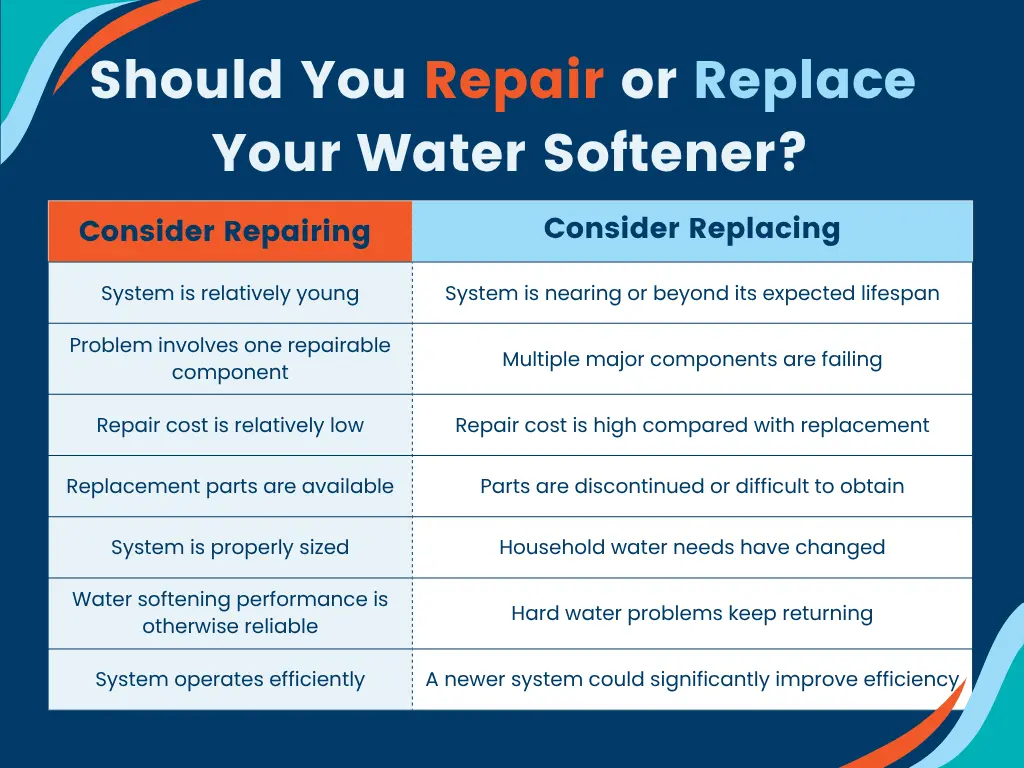
Before investing in either option, have a water treatment professional evaluate the equipment and test your water.
When Should You Switch to Portable Exchange Tank Service Instead?
Replacing an aging water softener doesn’t necessarily mean purchasing another traditional system.
For some Central Coast homeowners, portable exchange tank service may be an even better long-term solution.
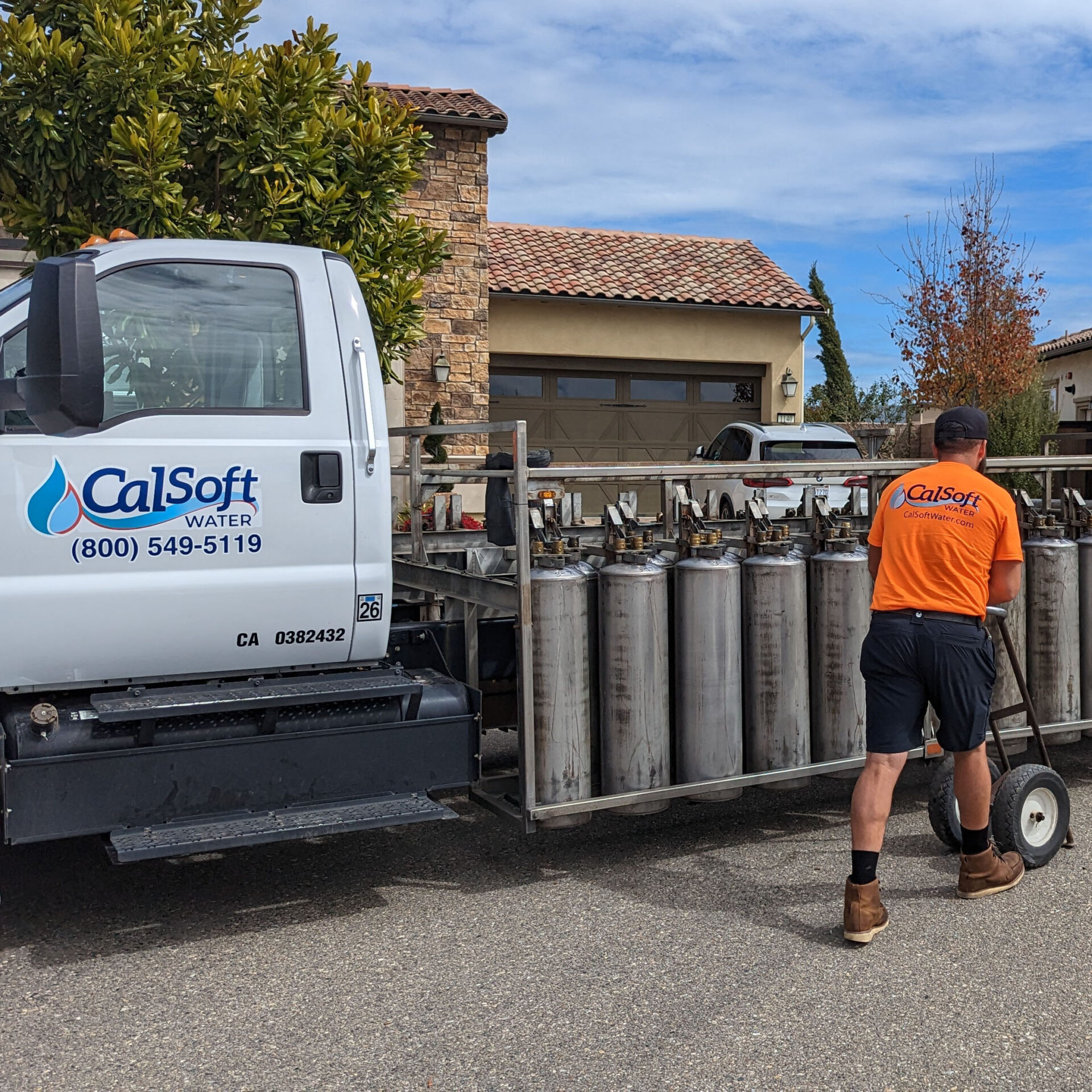
At CalSoft Water, we offer Portable Exchange Tank Service, also known as soft water delivery service, as an alternative to conventional automatic water softeners.
Instead of maintaining a system that regenerates at your home, you receive a professionally maintained tank containing regenerated water-softening resin. When the tank’s softening capacity is depleted, a CalSoft technician exchanges it for a freshly regenerated tank. The exhausted tank is taken to a centralized facility for regeneration.
This allows you to enjoy softened water without handling salt or managing regeneration equipment at home.
5 Reasons Portable Exchange Tank Service May Make More Sense
1. You’re tired of water softener maintenance.
Portable exchange service eliminates the need to add salt, monitor regeneration cycles, or maintain a conventional automatic softener yourself.
CalSoft technicians handle the tank exchanges and associated service.
2. You want to avoid buying another expensive system.
If your old water softener needs replacement, portable exchange service offers an alternative to purchasing a new automatic softener.
Instead of making a large equipment investment, you pay for ongoing service.
3. You want to reduce water usage at home.
Traditional water softeners use water during regeneration.
Portable exchange tanks don’t regenerate at your home, eliminating household water consumption associated with that process.
This can be particularly appealing in California communities where water conservation is a high priority.
4. You want to avoid salt storage and brine discharge at home.
Portable exchange tanks don’t require you to add salt.
In addition, regeneration occurs at a centralized facility rather than at your property, so the system doesn’t discharge regeneration brine into your home’s wastewater system.
This can be useful where local discharge restrictions or property limitations make traditional softeners less practical.
5. You want convenient, professionally managed soft water.
At CalSoft Water, we offer portable exchange schedules of 7, 14, or 28 days, depending on household water usage and hardness.
You don’t need to be home for many scheduled exchanges.
This makes portable exchange service especially appealing to busy homeowners, retirees, and anyone who wants the benefits of soft water without maintaining conventional softening equipment.
Is Portable Exchange Tank Service Better Than Buying a New Water Softener?
Not necessarily. Each option has advantages.
A traditional water softener may be the better choice for homeowners who prefer owning their equipment and are comfortable handling routine maintenance.
Portable exchange tank service may be preferable for those who prioritize convenience, minimal on-site maintenance, and avoiding regeneration-related water use at home.
There is also a financial difference to consider.
Buying a water softener generally involves an upfront investment plus ongoing operating and maintenance costs.
Portable exchange service involves recurring service fees.
The best long-term value depends on your household’s water usage, water hardness, budget, and preferences.
For a more detailed comparison, read our article, Renting vs. Buying a Water Softener: Which Option Makes the Most Sense?.
How to Extend Your Water Softener’s Lifespan
Whether your system is two years old or twelve, proper maintenance can help you get the most from your investment.
Here are several practical steps homeowners can take.
Check Salt Levels Regularly
For traditional salt-based water softeners, keep an appropriate amount of salt in the brine tank according to manufacturer recommendations. Avoid allowing the tank to run completely empty, and watch for salt bridging.
Use the Correct Water Softener Salt
Not all water softener salt products are identical. Use the type recommended for your equipment to help minimize buildup and maintain reliable operation.
Test Your Water Periodically
Water that looks clear isn’t necessarily soft. Testing your water hardness can help confirm whether your system is removing calcium and magnesium effectively.
This is especially helpful if you’ve noticed changes in water quality.
Keep Your System Properly Programmed
Regeneration settings should reflect your household’s water hardness and usage.
Incorrect settings may lead to unnecessary salt and water consumption or inconsistent softening.
Address Problems Early
Unusual noises, leaks, changes in salt usage, and returning hard water symptoms deserve attention.
Catching problems early may prevent more extensive damage.
Schedule Professional Water Softener Service When Needed
Professional maintenance can help identify worn components, verify settings, and evaluate overall system performance.
At CalSoft Water, we can assist with water softener maintenance, including filter changes and salt delivery. Our team can even add salt to your system for you.
Taking care of your existing equipment may help delay the need for replacement.
Why Water Softener Lifespan Matters for Santa Maria and Paso Robles Homeowners
Hard water is a familiar challenge for many homeowners throughout Northern Santa Barbara and San Luis Obispo Counties.
In communities such as Santa Maria and Paso Robles, high mineral concentrations can create persistent problems with scale buildup, spotted dishes, and mineral deposits on fixtures.
A properly functioning water softener helps manage these issues by removing hardness minerals before they travel throughout your home’s plumbing.
However, the right system depends on more than your city or ZIP code.
Your home’s actual water hardness, household size, plumbing configuration, and water consumption all affect which treatment solution makes the most sense.
For example, a large household with extremely hard water may need a different softening capacity than a smaller home with moderate water hardness.
Similarly, homeowners interested in conserving water or eliminating salt handling may prefer portable exchange tank service.
That’s why professional water testing and personalized recommendations are so valuable.
How CalSoft Water Can Help You Repair, Replace, or Upgrade Your Water Softener
If your water softener isn’t performing as well as it used to, you don’t have to guess whether it’s time for a new one.
The experienced team here at CalSoft Water helps Santa Maria and Central Coast homeowners understand their water quality needs and explore practical treatment options.
Whether your current water softener needs maintenance, you’re considering an upgrade, or you’d prefer a low-maintenance alternative, we can help you evaluate your choices.
Water Softener Maintenance and Service
If your existing system is still in good condition, maintenance or a targeted repair may be all that’s needed.
Our experts can help evaluate performance concerns and determine what service options are appropriate.
New Water Softener Installation
If replacement is the better investment, we offer quality residential water softeners designed to provide dependable soft water.
Our experienced technicians can help determine the appropriate system for your home’s water hardness and daily usage.
Portable Exchange Tank Service
If you want soft water without maintaining a traditional softener, CalSoft’s portable exchange tank service offers a convenient alternative.
We handle tank exchanges and regeneration, eliminating the need for salt handling and on-site regeneration.
Personalized Water Treatment Recommendations
Not every water quality concern can be solved with a water softener alone.
If you’re also experiencing unpleasant taste, odor, or other water quality issues, we can help you explore additional treatment options, including drinking water systems and filtration.
Frequently Asked Questions About Water Softener Lifespan, Repair, and Replacement
How long does a water softener last on average?
Most traditional water softeners last approximately 10 to 15 years. However, high-quality systems that receive proper maintenance may last 20 years or longer. Water hardness, usage, maintenance, and equipment quality all influence the actual lifespan.
Can a water softener last 20 years?
Yes. Some water softeners can last 20 years or more, particularly if they are well maintained and have durable, serviceable components. However, an older system should be evaluated for efficiency, reliability, and the cost of future repairs.
How do I know if my water softener is going bad?
Common warning signs include returning hard water symptoms, excessive or unusually low salt consumption, irregular regeneration, leaks, decreased water pressure, and repeated repairs. A professional inspection can help identify the cause.
Is it worth repairing a 10-year-old water softener?
Often, yes. If the problem is relatively minor, replacement parts are available, and the system is otherwise in good condition, repairing a 10-year-old water softener may be worthwhile. The repair cost and overall equipment condition should guide the decision.
Should I replace a 15-year-old water softener?
Not automatically. If your system is still operating efficiently and consistently producing soft water, replacement may not be necessary. However, major repairs or repeated failures may make upgrading more economical.
How much does it cost to repair a water softener?
Repair costs vary based on the problem, equipment brand, replacement parts, and labor. Minor maintenance issues generally cost less than replacing a control valve or addressing major internal damage. A professional estimate can help you compare repair costs with replacement options.
Can a water softener stop working even if there’s salt in the tank?
Yes. A water softener can contain salt but still fail to soften water because of salt bridging, clogged components, incorrect settings, valve problems, or exhausted or damaged resin. Salt levels alone don’t confirm that the system is working.
Will a new water softener use less salt and water?
It may. Modern, properly sized demand-initiated water softeners can be more efficient than older systems that regenerate on a fixed schedule. Actual savings depend on your current equipment, water hardness, and household usage.
Is portable exchange tank service a good replacement for an old water softener?
For many households, yes. Portable exchange tank service provides softened water without requiring homeowners to purchase and maintain a traditional automatic softener. It can be especially appealing to people who want convenience, no salt handling, and no on-site regeneration.
Does portable exchange tank service use salt?
The ion-exchange resin is regenerated using salt at a centralized facility, but homeowners don’t need to purchase, store, or add salt at their property. The tanks also don’t discharge regeneration brine at home.
Is it better to repair or replace a water softener in an area with very hard water?
The decision depends on the system’s age, condition, capacity, and repair cost. In very hard water areas such as Santa Maria and Paso Robles, proper sizing and efficient operation are particularly important. A professional evaluation can determine whether your existing softener is still adequate for your household.
Should You Repair, Replace, or Switch Your Water Softener? Let CalSoft Water Help You Decide
If your water softener is getting older or no longer delivering the results you expect, you have options.
A simple repair might extend its useful life for several more years. A new, more efficient water softener could provide better long-term reliability. Or, if you’re ready to stop dealing with salt and equipment maintenance, portable exchange tank service might be the perfect solution.
The key is choosing the option that makes the most sense for your water quality, household needs, and budget.
At CalSoft Water, we help homeowners throughout Santa Maria, Paso Robles, and surrounding Central Coast communities find practical solutions to hard water problems. Whether you need help maintaining your current equipment, selecting a replacement water softener, or exploring the convenience of portable exchange tank service, our experienced team is ready to help.
Ready to find out whether your water softener should be repaired or replaced?
Contact us today to discuss your water treatment needs and request an estimate.